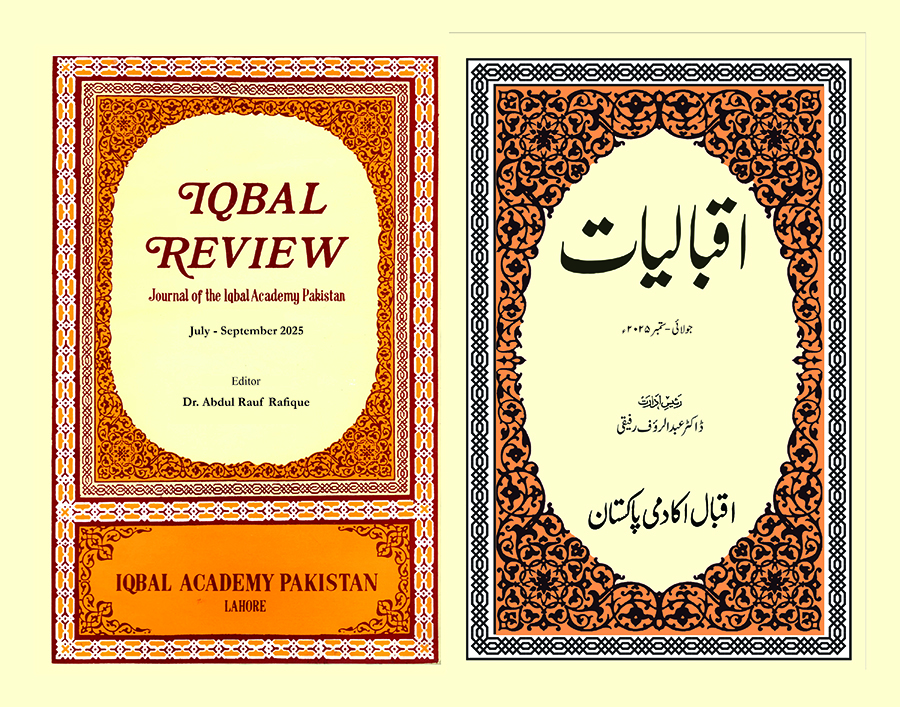
گلشن راز جدید- اقبال کا تصور تصوف اور فلسفہ خودی
Gulshan-e-Raz-e-Jadeed: Iqbal's Vision of Tasawuf and the Philosophy of the Self
Keywords:
Gulshan-i-Raz Jadid, Shaykh Mahmud Shabistari, Wahdat al-Wujud, Fana fi Allah, Khudi, Qur’an and Sunnah, Fitnah-i-Farang, Intellectual and spiritual revivalAbstract
The Masnavi Gulshan-i-Raz Jadid is a masterpiece of Allama Iqbal’s Persian poetry, included in his collection Zabur-i-‘Ajam. This Masnavi was written as a response to the renowned work Gulshan-i-Raz by Shaykh Mahmud Shabistari, composed seven centuries earlier. While adopting most of Shabistari’s questions, Iqbal provided answers in the light of the intellectual and cultural conditions of his own era, as well as the guidance of the Qur’an and Sunnah. Whereas Shabistari, within the framework of the philosophy of wahdat al-wujud (unity of being), regarded annihilation in God (fana fi Allah) as the pinnacle of human perfection, Iqbal considered the affirmation and perfection of the self (khudi) to be the true summit of life. The background to the creation of this Masnavi, in Iqbal’s view, lay in diagnosing the intellectual and spiritual decline of the Muslim Ummah and offering its remedy. He reinterpreted the ancient Sufi terminology to suit the needs of the modern age and presented an intellectual and spiritual manifesto against the Western colonial challenge (fitnah-i-Farang). Consisting of 326 verses, this Masnavi forms a vital link in Iqbal’s intellectual evolution—from Asrar-i-Khudi through to Javid Nama and the Lectures—in which self-knowledge, the strengthening of the self, and ceaseless action remain the central themes.